Careers
27 Oct 2025
Sir Jeremry Hunt
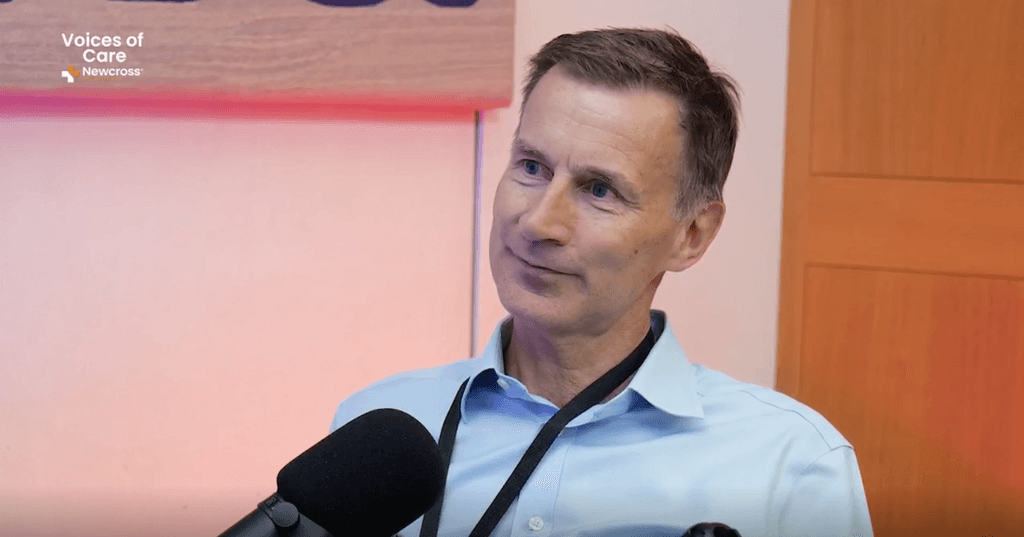
Sir Jeremy Hunt calls for cultural revolution in NHS, demands merger of health and social care systems, and warns blame culture is blocking patient safety improvements
The UK's longest-serving Health Secretary has issued a direct challenge to the Government's NHS 10-Year Plan: the NHS doesn't need more money—it needs a cultural revolution.
Speaking on Newcross Healthcare's Voices of Care podcast with host Suhail Mirza, Rt Hon Sir Jeremy Hunt, former Health Secretary, Chancellor and Foreign Secretary, outlined his vision for transforming the NHS while warning that social care reform remains "unfinished business."
FUNDING NOT THE PRIMARY ISSUE
Sir Jeremy stated: "today, out of 38 countries in the OECD, the advanced economies, the NHS actually gets the fifth highest funding of all of them as a percentage of GDP."
He added: "I don't think we can really look at the NHS now and say funding is the issue."
10-YEAR PLAN: TACTICAL NOT TRANSFORMATIONAL?
While acknowledging positive elements in the Government's approach, Sir Jeremy expressed significant reservations. "I think there are some good things in the plan, and I, I wish wes streeting well," he said, before adding: "but if I have a worry, I think that the thrust of the ten year plan is is very tactical."
He continued: "what we need in the NHS is a cultural change."
Sir Jeremy warned: "there is too much top down control, and we are forcing managers to follow bucket loads of targets."
He explained the impact: "the unintended consequence of this is that patients remain numbers and not human beings."
PATIENT SAFETY: 13,500 AVOIDABLE DEATHS
Drawing on his tenure as Health Secretary, Sir Jeremy highlighted patient safety as his defining achievement. He revealed: "at the moment the NHS has about 13,500 avoidable deaths."
On the economic case for safer care, he cited OECD data: "10% of the costs in modern healthcare systems are hospitals putting right mistakes they've made."
He quoted patient safety pioneer Dr Gary Kaplan: "the path to safer care is the same as the path to lower cost."
Reflecting on his own record, Sir Jeremy shared: "the number of baby deaths had gone down by 15%, which is basically about two fewer deaths a day." He added: "I think of all the things I've done, that's the thing that I will be most proud of until the day I die."
FROM BLAME TO LEARNING: THE CULTURAL BARRIER
Sir Jeremy revealed the staggering cost of the current system: "we now spend more on settling claims for maternity lawsuits than the cost of every single doctor or maternity nurse or midwife in the NHS."
He identified the blame culture as blocking progress: "what we need to do is to move away from a blame culture to a learning culture where when a tragedy happens" healthcare professionals can speak honestly.
He was critical of past cover-ups: "the previous Labour government covered up what happened in Mid Staffs for nearly four years."
He stated: "only when you are honest about the problem do you then create the momentum for a solution."
Reflecting on his time in office, Sir Jeremy said: "I realised the only permanent change is cultural change."
SOCIAL CARE: "UNFINISHED BUSINESS" AND THE INTEGRATION IMPERATIVE
Sir Jeremy described social care as "unfinished business" and outlined the current situation: "at the moment, the sector is in crisis and it's not really clear how it's going to get out of that crisis."
During his time as Chancellor, he attempted to address the funding crisis: "when I was Chancellor, I did try and address some of the unfinished business in the autumn statement of 2022. My first fiscal event, when I gave a 38% increase to the social care budget, I think its biggest ever increase historically."
However, he said funding alone is insufficient: "I think that we allowed the social care debates to be to become something about helping middle England protect their inheritances."
Sir Jeremy made the case for integration: "I think the most important thing to recognise is that we won't solve the problems in the NHS unless we solve the problems in social care."
His proposed solution represents significant structural reform: "I think what we need to do is at a local level, we need to fully merge the social care and NHS systems."
He expressed frustration at the current Government's approach: "that is a big reform, which I don't hear anything about from the government."
BRITAIN'S GLOBAL ROLE IN HEALTH INNOVATION
Drawing on themes from his latest book "Can We Be Great Again?", Sir Jeremy said: "I think we've got into this kind of national state of doom and gloom."
He highlighted Britain's pandemic contribution: "in the pandemic, vaccines and treatments discovered in the UK saved about 7.5 million lives globally."
With America potentially reducing its research commitment, Sir Jeremy identified opportunity: "under President Trump, America seems to be cutting back. I think they've cut Harvard's research budget in half."
He stated: "there's a really big role for countries like the UK in helping to stop future pandemics."
On Britain's future positioning, Sir Jeremy said: "I think we need to get our mojo back."
He added: "the world is a very dangerous place. And my argument in the book is that countries that have influence, and we are one of those, should use that influence."
LESSONS FROM INDUSTRIAL DISPUTES
Reflecting on his experience with the junior doctors' strike, Sir Jeremy stated: "in retrospect, I wish that I'd had the battle with consultants rather than junior doctors."
He warned: "there are inside some of the health unions, particularly the BMA, some very politically motivated people."
On the current Government's approach to pay settlements, Sir Jeremy said: "I think that with the benefit of hindsight, probably what happened in the first months of the Parliament was unwise."
END
The Voices of Care podcast, hosted by Suhail Mirza, continues to provide a platform for sector leaders to address critical issues facing health and social care across the UK.
Contact: Newcross Healthcare – Omar Eissa, Marketing Manager
omar.eissa@newcrosshealthcare.com
About the Voice of Care Podcast
The Voices of Care podcast, a Newcross Healthcare production hosted by Suhail Mirza, offers candid conversations with key figures in health and social care. Created to give a platform to those shaping the future of care, the podcast explores the biggest challenges facing the sector while spotlighting inspiring stories of innovation and leadership.
About Newcross Healthcare
Newcross Healthcare is one of the UK's leading providers of social and health care services, both within the community and through healthcare staffing. With an extensive network of over 165,000 registered healthcare professionals and nearly three decades of expert experience, Newcross delivers high-quality care solutions that meet the diverse needs of patients and communities.
For more information, visit www.newcrosshealthcare.com