Careers
23 Feb 2026
Rukshana Kapasi
Barnardo's Director of Health, calls for measurable accountability in government's ambition to create "healthiest generation of children" and urges neighbourhood health models to truly partner with voluntary sector
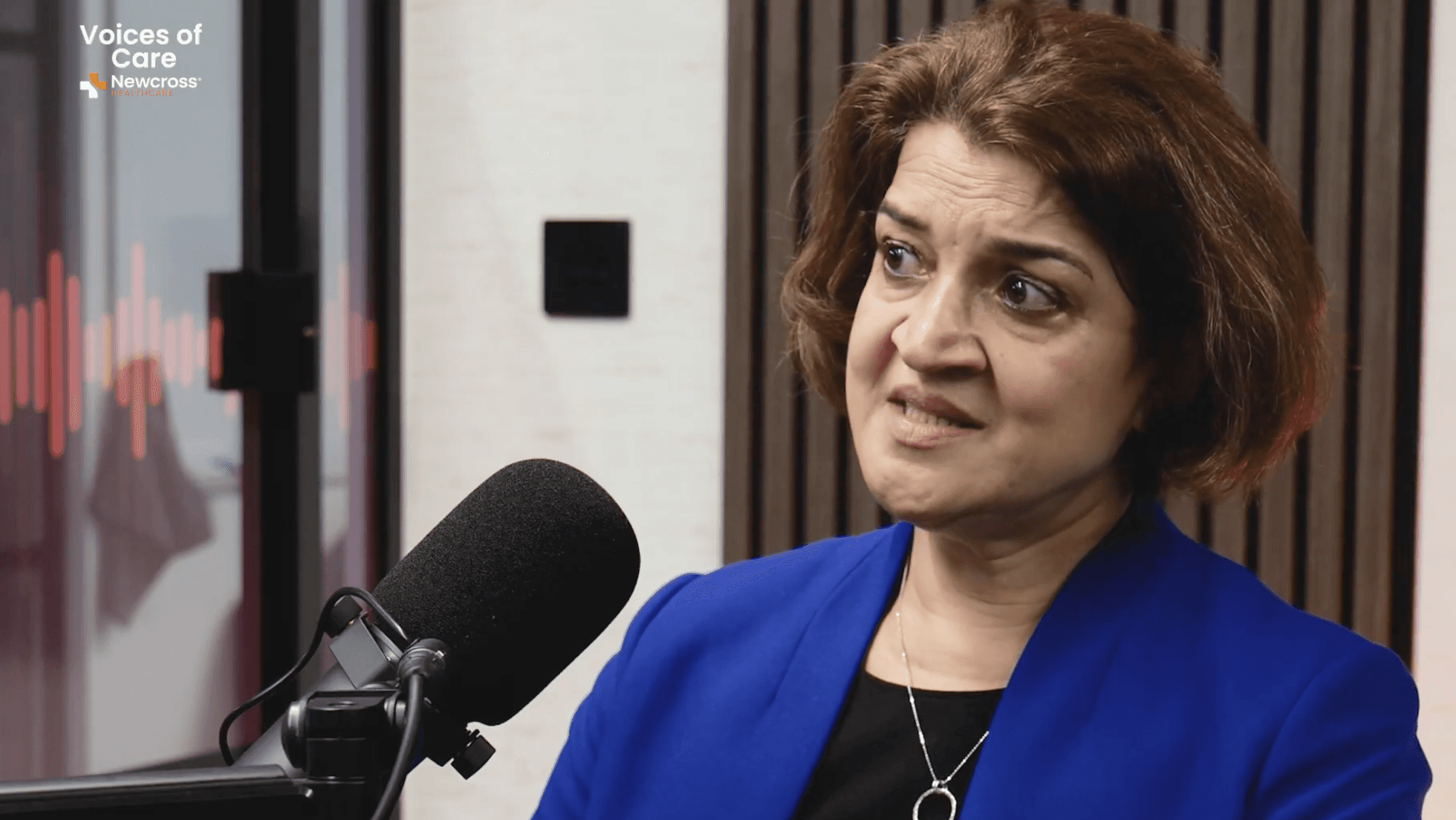
In a powerful episode of the Voices of Care podcast (sponsored by Newcross Healthcare), Rukshana Kapasi OBE, Director of Health at Barnardo's, has issued an urgent call for the government to back its ambitious child health policies with concrete metrics and genuine partnership with the voluntary sector - or risk seeing children's health fall down the priority list once again.
Speaking with host Suhail Mirza, Kapasi - who was awarded her OBE for transforming care and championing health equity and the voice of patients - welcomed the government's bold commitment to create the healthiest generation of children but warned that without proper measurement and accountability, the vision risks remaining just that: a vision.
THE MEASUREMENT PROBLEM
"One of the things that will stop the ambition turning into a reality is that at the moment we haven't got any metrics around what the healthiest generation looks like," Kapasi explained. "We know that actually we value what we measure. "
Her warning is stark: "Children will just fall off the priority list again and just be an extension of the adult population, which I think they have been for so long."
POVERTY'S DEVASTATING REACH
The scale of the challenge is immense. With 4.5 million children currently living in poverty in the UK, Barnardo's - which supported 350,000 children through 650 services last year - is at the frontline of tackling the crisis.
Kapasi, whose own mother's experience with Crohn's disease helped inspire her career in healthcare, understands intimately how poverty compounds health challenges. Through Barnardo's services, she sees daily how "poverty really affects a child's chances right into adulthood."
The charity's work in emergency departments revealed a troubling pattern: families referred for non-clinical health needs - "because of their housing circumstances, because they had rats and mice crawling on the floor, they weren't able to sleep, resulting in mental health issues or the damp and mould meant that they came 17 times in six months to A&E for respiratory issues."
PROVEN SOLUTIONS DELIVERING REAL IMPACT
Barnardo's has developed innovative models that demonstrate remarkable results. Their family support worker programme showed that "97% of people that came said that they wouldn't come back for the same issue again to A&E once they had had an intervention from our family support worker."
The return on investment? "For every one pound invested, it was saving the system three pounds five pence."
The charity's virtual family hub model is proving equally transformative in reaching underserved communities. In Croydon, "52% of those attending were actually from the most deprived postcode areas" - families who might never have accessed traditional face-to-face services due to work commitments, disability access issues, or stigma.
MENTAL HEALTH CRISIS DEMANDS URGENT ATTENTION
On children's mental health, Kapasi praised the government's commitment that every school child would have access to mental health support teams, but warned these models don't work optimally for all children - particularly younger children or those with special educational needs and complex mental health problems who "may not meet the CAMHS threshold, so they're likely to be the missing middle that falls through the gap."
Barnardo's BIRD resilience model has shown extraordinary results, achieving "a 2.87% re-attendance to A&E - the normal rate is 20%."
THE VOLUNTARY SECTOR MUST BE TRUE PARTNERS
Perhaps Kapasi's most important message concerns how neighbourhood health centres - central to the government's 10 Year Health Plan - must be designed and governed.
"The neighbourhood models that are coming out seem to be quite clinically focused at the moment - they need to expand out into a much broader partnership model that goes beyond health," she urged. "If we are going to be person-led and we're going to use the assets in the community, we need to be working with children, young people and all of those people affected by services."
Her call is clear: "Every new service model, service redesign or initiative like Neighbourhood Health should have co-production involving children and young people at the heart of it. We know it makes such a difference. If you design services with children and young people, they're more likely to work, they're more likely to be sustained, and you are going to get better outcomes."
A VISION FOR REAL CHANGE
Drawing on groundbreaking work with Sir Michael Marmot and the Children and Young Persons Health Equity Collaborative - which uniquely involved 300 children in developing its framework - Kapasi demonstrated how the voluntary sector can drive system change.
In Birmingham and Solihull, this work led to the ICB doubling social value requirements in supplier contracts from 10% to 20%, with corporates now matched with community organisations to fund prevention work.
Kapasi's message to government is one of both celebration and challenge. She welcomes unprecedented policy alignment around child poverty and health but insists: "Social impact and the economic value of prevention needs to be really articulated in policy more, but also in the resource allocations that local authorities and ICBs make."
Her closing vision is an inspiring call to action honouring the more than 150 years of Barnardo’s history supporting children and young people: "Imagine what a difference it would make if you had a family support worker or a mental health wellbeing worker in every single emergency department, in every single neighbourhood team, in terms of how that affects how the NHS is used in the future and the pressures that the NHS thereby may not experience going forward."
END