Careers
2 Feb 2026
Helen Dent

Helen Dent, CEO of the British In Vitro Diagnostics Association, reveals how outdated procurement practices are potentially costing the NHS millions and could be damaging the health of the economy (and patients) as companies decide to launch life-saving technology in other countries
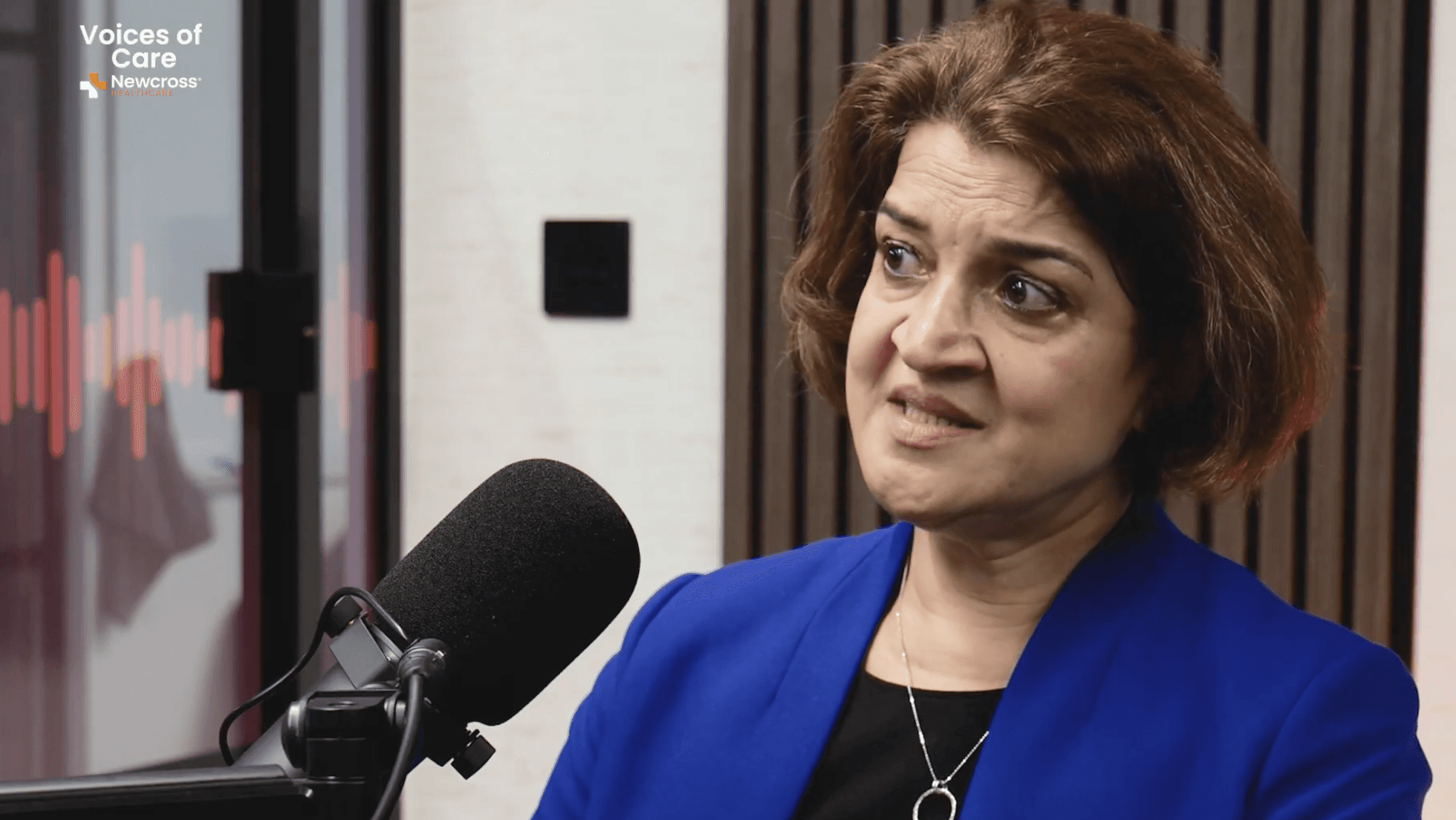
The NHS is imposing "huge costs on itself" through outdated funding practices that are simultaneously draining budgets and blocking access to innovative diagnostic technologies, according to Helen Dent, Chief Executive of the British In Vitro Diagnostics Association (BIVDA), speaking on Newcross Healthcare's Voices of Care podcast with host Suhail Mirza.
In a wide-ranging conversation recorded to discuss the Government ten-year health plan and vision for Life Sciences, Dent delivered a stark assessment of how the healthcare system's approach to diagnostics—which underpins so much clinical decision making—is creating a perfect storm of wasted resources and missed opportunities.
THE £70,000-PER-ANALYSER WASTE
Dent revealed that hospitals are paying vastly inflated costs for diagnostic equipment due to overly long-term revenue contracts attracting a high cost of capital—a practice she described as fundamentally inefficient.
"The NHS has imposed a huge cost on itself by not having the capital money for this," Dent stated. "If the government would issue capital funds to purchase capital diagnostic equipment for in vitro diagnostics, not only would that remove the capital cost, it would also kickstart some of the other things in the life science sector plan."
The savings are potentially staggering; Dent gave an example of a single analyser with a list price of £120,000, arguing providers could save up to £70,000—representing potential savings of 30-35% across diagnostic equipment procurement.
"It's a win-win to stop funding these types of contracts through day-to-day revenue," Dent argued, explaining how capital funding would simultaneously reduce NHS costs, encourage innovation, and strengthen the UK's life sciences sector by making the UK more attractive to investors.
UK BECOMING A "THIRD OR FOURTH COUNTRY RELEASE"
But the cost issue is only part of the problem. Dent warned that regulatory barriers and procurement delays are pushing innovative UK companies to launch products abroad first, with Britain increasingly becoming an afterthought in the global diagnostics market.
"If you don't have the uptake and if you don't have the money available to do something else, then they will launch that elsewhere. And then the UK can be maybe a third or fourth country release," she revealed.
The consequences extend beyond economics. "We've been saying that diagnostics should be at the forefront of everything for probably thirty years," Dent highlighted.
TECHNOLOGY EXISTS—PATHWAYS DON'T
Perhaps most frustrating for the sector is that solutions to many current NHS challenges already exist but aren't being deployed.
"Certainly, a lot of point of care and community diagnostics could be done because the technology, the science and the products are available," Dent explained. "It's the pathway and it's the processes around it that need the work doing to it."
She pointed to antimicrobial resistance (AMR)—which the WHO identifies as one of the top ten threats to global public health—as an area where diagnostic testing could make an immediate impact by ensuring antibiotics are prescribed appropriately.
"I think the AMR challenge is a lot about investment, a lot about science, a lot about research, but it's also about us changing our behaviour," Dent said, emphasising that diagnostic tests can quickly determine whether infections are bacterial or viral, and even identify which specific antibiotic would be most effective.
PROCUREMENT "FRUSTRATION" AND THE INNOVATION TRAP
Dent didn't hold back in her critique of NHS procurement processes, which she described as "overcomplicated" and creating barriers to innovation that ultimately could delay or deny access to technology for patients.
"Procurement frustrates me because it's been overcomplicated," she stated. The system, she explained, has created a catch-22 where even government-funded innovations struggle to reach patients.
"When you have got government-funded innovations—it's been through Innovate UK, it's been through NIHR—it's actually ready for market, there shouldn't be a question whether somebody purchases it or not," Dent argued. "It should be a case of right, this is ready for market, go for it."
She noted that the National Institute for Health and Care Excellence (NICE) assessment process "works very well for the larger companies because they've got the funds to put it through" but creates existential challenges for smaller innovators: "You tend to see that it doesn't help smaller companies or SMEs with some of the best technology."
A CALL FOR SYSTEMIC CHANGE
Looking ahead, Dent called for fundamental reforms including:
A National Director for Diagnostics to coordinate decision-making across the system—but warned this must be a genuinely empowered role, not simply another layer of bureaucracy
Procurement innovation champions across departments—provided they have sufficient seniority and resources to drive real change
Strategic work across life sciences to establish which diagnostic tests should be done where, when, and with what technology
Shorter procurement cycles (7-10 years instead of 15-20) to allow innovation cycles to align with contract renewals
SUSTAINABILITY REQUIRES INDUSTRY PARTNERSHIP
In a pointed reminder to policymakers, Dent argued that true sustainability in healthcare requires recognising industry as an equal partner alongside environmental and financial considerations.
"The NHS and the government need to look at industry as the third part of sustainability," she said. "If you don't invest in your industry, you do not have that third part of sustainability. And if you don't have that third part of sustainability, by its very definition, you are not sustainable."
As the government seeks to implement its 10 Year Health Plan and Life Sciences Plan (with diagnostics positioned as central to achieving goals around community care, prevention, and digital transformation) Dent's message is clear: the technology exists, the opportunities are enormous, but systemic barriers must be dismantled for patients to realise the full benefits
"It is essential. Diagnostics are central to everything," Dent concluded. "If we don't look at how those two plans can work together with industry in order to get this technology into the market, we are only going to be further down the line where we are now with lost opportunities, more waste, and a loss for the patients."